
NEWSLETTER
JOIN US FOR DINNER!
CLICK FOR KARNEVAL INFO
Web Page
3 of 3


Please Allow
1 Full Minute
for Entire WebPage To Appear - Thank You!
Home
Familienkreis
(CLICK PHOTO TO ENLARGE)
click to enlarge
click to enlarge
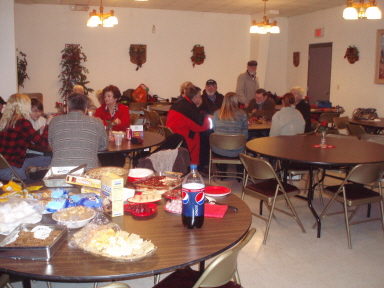
Our Club Chef invites you to
Home Cooked WEDNESDAY NIGHT DINNERS
Every Wednesday, Germania Club invites the public to be our guest at dinner.  Dinner is served from 5:00pm to 7:00pm.
The cost is $8.50 .   Our very reasonable cash-bar of fine German beers, wines & liqueurs is also available. 
Please join us for dinner!!!
Club Wednesday Night Dinner MENU

All Dinners Include:  Spaetzel, Mashed Potatoes & Gravy, Red Cabbage,
Chef's Choice Vegetable, Salad, Bread or Roll & Butter, Coffee or Tea, and Dessert
October 7 - Sauerbraten, or Schnitzel

October 14 - Kassler Smoked Pork Chops, or Schnitzel

October 21 - Rouladin, or Schnitzel

October 28 - Baked Chicken, or Schnitzel


Cash Bar 
KARNEVAL
FOTOALBUM
Mit Familie, Freunde und Gaste

(click number to see photo of our
Internet and Computer Support Staff)
CLICK TO SEE PHOTO OF OUR INTERNET AND COMPUTER SUPPORT TEAM
click to return to top of pageclick to return to top of pageclick to return to top of page
KÖLNER KARNEVAL

In Cologne they call Karneval--the period between November 11 and Ash-Wednesday--the "Fifth Season of the Year".
These opening ceremonies are when the Karneval Honor Guard--at least in the Rhineland, in Cologne, Bonn or Mainz-- is on the march. The jesters flood into the streets, and for one great day they revel in merry anticipation. Then it's over again for a while--but only for outsiders. In carnival clubs, street and neighborhood groups, there are now regular meetings and activities, as the preparations for "die tollen Tage," the crazy days to come, are in full swing.

After that official initiation in November, Karneval festivitiea resume on New Year's Day or immediately following "Twelfth Night" (the Festival of the Epiphany), on January 6, and ends with Ash Wednesday, the first day of Lent. At those parties, dances and balls, folks wear "Kappen" (fools caps) and often wild masks and costumes.
In each city a Prinz Karneval, referred to as "His Crazy Highness," is elected to head with his princess, or Prinzessin; and a retinue of fools, his "court of fools",  that lead the frolics.

On Shrove Tuesday the crazy couple will move with their retinue into the Rathaus (City Hall) to govern until midnight, when the merrymaking and foolishness comes to a sudden halt, yielding to the observation of Lent.

ROOTS OF KARNIVAL
The Karneval of Cologne has its roots in ancient times. Cologne, founded by the Romans in 38 B.C. was named Colonia Claudia Ara Agrippinensum, after Julia Agrippina, daughter of the Roman General Germanicus, who married Rome's Emperor Claudius.

The cultures that evolved in Cologne side by side, the Roman and the Germanic, laid down the roots of Karneval.
Numerous features of Karneval such as the masks, fancy costumes, parades and floats were also part of the ancient Roman Saturnalia (in December) and Lupercalia festivities (in February).
Blended with the Germanic peoples' rites of Spring, they became the foundation upon which the Christian Church laid new interpretations and symbols of that religious season.
The early Karneval celebrations in Cologne had been organized by craft guilds. In 1823, citizens formed Karneval societies and the Romantic spirit of the times and renewed interest in classic Greece and Rome, provided inspiration for Karneval themes. A symbolic figure, "Prinz Karneval" and his "Pinzessin, assisted by two other picturesque figures; the "Kouml -- lnische Bauer" (Cologne Peasant) and the "Kouml -- lnische Jungfraü (Cologne Virgin, portrayed by a man) became the principals.
The numerous independent parades of masked groups were combined into one big parade culminating in the "Prince's" float.

Organized by firmly established Karneval societies, independent groups, which sometimes competed with one another, Karneval began to flourish. Extremely elaborate gatherings were held for the preparations. From these gradually developed today's popular "Kappensitzungen" (fools' sessions), often shown on TV. The Cologne practice spread to other Rhenish cities, Mainz and Düsseldorf.

MODERN KARNEVAL - COLOGNE
Today, "Karneval in Köln" is bigger, noisier and merrier than ever. The Rhenish Karneval traditions are shared with Mainz and Düsseldorf as well as the larger and smaller towns in the vicinity of Cologne. Along the Rhine every town has a "Prinz" and "Prinzessin" (Prince and Princess) who command a uniformed guard, the "Prinzengarde" (Prince's Garde), and parades with brass bands, dancers, officers on horseback, musketeers and infantrymen, all dressed in 18th century costume.

Before the season culminates in the Rose Monday Parade, there are balls, parties and the famous "Büttensitzungen". 
"Bütten" (barrel) speakers are expected to be hilariously funny, witty and clever. The speeches range from funny to satirical and highly political. The speakers enjoy "Narrenfreiheit" (fools' liberty) as the license of the traditional court jester who had the liberty to speak unpopular truths as long as they were cloaked into the forms of jokes. Such an evening is further enlivened by skits, dance entertainment, music, and much food, libation and song.

Karneval is also the high season for "Tünnes und Schäl," two characters, who illustrate and poke fun of the good citizens of Cologne. Tünnes, a somewhat simple and good natured 'man from the countryside', but no dummy, is dressed in casual and not necessarily matching attire, while Schäl, correct in derby hat and tie, displays proper, conforming respectability. Together they enliven Karneval events and festivities. Tünnes and Schäl jokes abound, often addressing, with humor, political and civic issues.

ROSE MONDAY
Since the Karneval season began in November, the "Elferrat" (Council of Eleven) together with other Karneval societies have planned the festivities that reach their climax in a huge Rose Monday parade with floats, representing satirical, political and traditional topics. This is the culmination of many months of parties and events by city carnival societies.
The Rose Monday parade, as is the entire carnival season, is presided over by the "Dreigestirn" (the Triumpherate), Prinz and Prinzessin Karneval, the Maiden (portrayed by a man) symbolizing the city of Cologne, the Bauer (farmer), representing the tradesmen and farmers who made Cologne great, and their entire court. These offices are very highly coveted and usually go to prominent citizens --- as it is not inexpensive to be a member of the "Triumpherate".

The parade, which is several miles long,  is repleat with uniformed contingents, brass bands, dancers and the famous floats; satirizing current politics with huge Papier-mache figures. The persons on the floats throw tons of "Kamelle" (candy) into the crowds who line the streets in the hundreds of thousands.
PRINZENGARDE UND FUNKENGARDE
In the parade also marches the "Kölsche Funke" ("sparks" or Karneval Society members) and the "Prinzengarde" (prince's guard) created as a parody of a Prussian drill team.
Dressed in 18th century uniforms with red coats, white wigs and three-cornered hats, this drill team carries out some irreverent maneuvers, occasionally bending over and wagging their posteriors at authority.

With them march the Funkengarde dancers or "Funken Mariechen" (Mary of the Sparks,) high stepping dancing majorettes, girls and women dressed in white wigs, three-pointed hats and red uniforms. On Karneval floats and during celebrations, they dance, do cartwheels, the splits and get lifted high by their partners. The performances of the Funken Mariechen have, over the years, led to a very specific and acrobatic dance form, and there are serious annual competitions held.
KEHRAUS
In the climactic end phase of the Karneval season, from Sunday to Tuesday, normal life in Cologne comes to a virtual standstill. The key to the city is taken away for the "drei tollen Tage" by Prinz Karneval. Shops, offices, and public buildings are closed.
On "Faschingsdienstag" (Shrove Tuesday) it all ends with the "Kehraus" (from auskehren, to sweep out) when, by the stroke of midnight, the merrymaking comes to an end. Crowds may gather to observe the burning of the spirit of Karneval in effigy. On Ash Wednesday begins the reflective period leading to Easter.


"Kölsch" -- Karneval in the Cologne dialect:
Alaaf - Helau: originally the greeting of the City of Cologne in the Rhineland, it means "Lebe hoch" and has become a Karneval greeting.
Helau: general expression of cheer and joyfulness.
Koelle Alaaf: a "cheer to the City of Cologne."
Elf: oldest Cologne Karneval motto "Ey Lustig Fröhlich - ELF."
Jeck: person born in Cologne.
Imi: Not born in Cologne, but living there.
All others: "Fründe" (Freunde), "Jäste" (Gäste) or "Besök" (Besuch).
Fasteleer or Fastelofvend: Karneval in Cologne.
Wieverfastelovend: the first day of the women's carnival. Tie wearers beware for, according to custom, your tie can be be cut off.
Zoch: (from Zug) parade.
Fastelovendszoch: Rose Monday Parade.
Funken: Jeckengroups in uniforms.
Sitzung: meeting of Faschingsverein, where there is music, singing, dancing and Schunkeln.
Schunkeln: you link arms with the persons next to you and swing with the music.
Bütten: a barrel.
Büttensitzung: The main feature of a Büttensitzung is that a speaker literally stands inside of, and speaks from a barrel.

click to return to top of pageclick to return to top of pageclick to return to top of page
Newsletters & Club Updates

Click the Link Below to View that Issue:


Carry-Outs Available!
PHOTOGRAPHS
click to return to top of pageclick to return to top of pageclick to return to top of page
Beverage Chairman Walt Bayko
trains a guest bartender
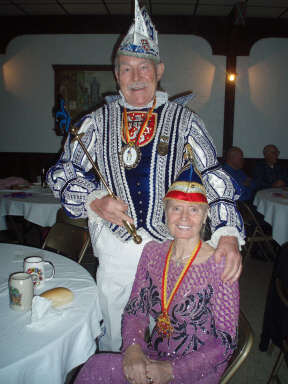
Prinz Timothy & Prinzessen Karen

SHOCKING PHOTOS OF CAPTIVE PRINCE SCEPTER OF LONDON
Brownstown, Michigan:  Recently, photographs have become public of the abduction of the Prince Scepter of London Ontario's K.G. Londoner Funken Rot-Weiss in 2001.  Following his disappearance rumors swirled about a captivity involving guns, liquor and women.  See our photo expose of this sordid affair, and his surprising confessions of debauchery.
Warning!  These photos may be too shocking for some.  
Prince Scepter takes an ungaurded, leisurely stroll in front of Germania Hall.
Taking in the fresh air and admiring the beautiful scenery in Brownstown.
(ALL PHOTOS CAN BE ENLARGED BY CLICKING ON THEM)
Enjoying some time with the friendly townsfolk ... or are they?
The evil Badder MeinKopf gang ... suddenly Prince Scepter is in a fight for his life!
A fierce gunbattle ensues.  Even though Prince Scepter is said to be an expert marksman ....he is a doomed man.
He never saw it coming ...
snuck up on from behind
in a moment it was all over
Held for interrogation by the high ranking
inteligencia officer
Comrade Ingrid
Prinz Timothy the Erste made sure that days and nights of non-stop beer, women and song ... would be more than Prince Scepter could resist
Then the mind control began ... first a visit with Chairman Bayko ... forced labor in the ausschank ...
Finally,  under the watchful eye of Happy Herbie and his Funky Mariechen, the change was complete ... Prince Scepter had become one of the Germania Downriver Gang ... but only for a moment .. then it was time to return to freedom.  "Hey, this is better than Club Med" the Prince was heard to say; "when can I come back?" .... that's hard to say ... unless you spend more time  ungaurded in Brownstown ... at Germania Hall you never know what might happen ...
(ALL PHOTOS CAN BE ENLARGED BY CLICKING ON THEM)
NEWSFLASH!!! Photos of the capture of Scepter of KG Londoner Funken Rot-Weiss - Click HERE
2004
Thank You to all the volunteers and attendees who made our Weihnachtsmarkt this year a great success!!
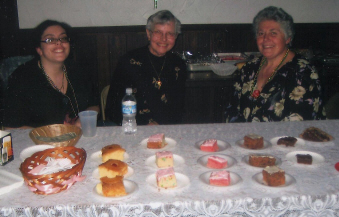
Lena, Rita and Ruth at the cake table
<--
-->
a colorful Lisa Hughes displays some embroidery available at the Market

Anne and dolls -
Red Hats in attendance too
Mary, Henry and Helga - Our hardworking kitchen staff
John Kopmanis Accordionist Extaordinaire plays for the Christmas crowd
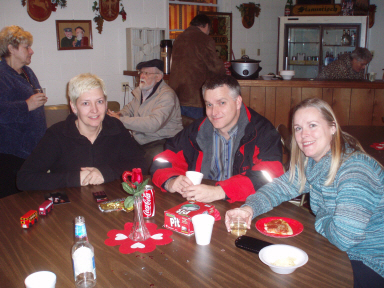
Some Smiling Faces From the 2004-2005
Karneval Closing Masken Ball
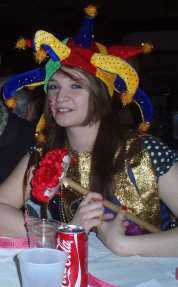
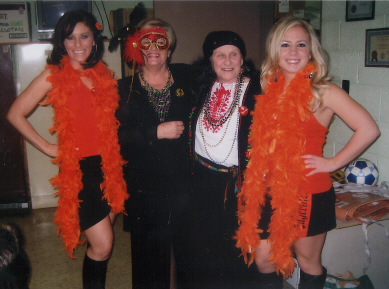
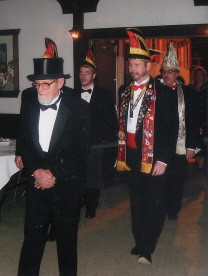
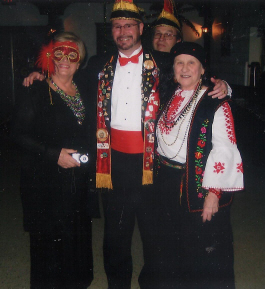
          Jester Sarah Kopmanis (center) entertained Janis Browne (left) and Peggy Mann at the Karneval closing celebration at the Germania Club Downriver on Feb. 5. The women, who donned beads, boas and feathered hats for the gala event, were among the prize winners for the best costumes.

click to return to top of pageclick to return to top of pageclick to return to top of page
(Also viewable in the
"Upcoming Live Music, Dances & Events"
section on the Homepage of this website.)